The Grahams of South Carolina
The Grahams of South Carolina are descended from the Reverend John Graham*, John Graham Jr., Narcissus Graham and John Christopher Graham
There are two publications dedicated to chronicling the family:
The Revererend John Graham of Woodbury, Connecticut and His Descendants, by Helen Graham Carpenter; The Monastery Hill Press; Chicago, 1942. 507 pages plus appendices and name index.
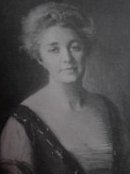
Helen Graham Fairbank Carpenter
(1868-1941)
The Reverend John Graham of Woodbury and His Descendants 2004, by Michael Warwick Graham. The book is a supplement to the above book and updates the family from South Carolina through 2004.
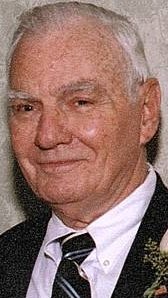
Michael Warwick Graham
(1924-2005)
The Reverend John Graham* (1694-1774)
During the difficulties which existed in Scotland growing out of the conflict between James II and the friends of William III (just before the Revolution of 1688), a younger branch of the house of Montrose took his wife and children over to the north of Ireland and left them there till the trouble at home should be over. While his wife remained in Ireland, she gave birth to her second son at Belfast, and called him John. This son remained with an aunt, at whose house he was born, till he was fitted for college. He then went to Glasgow, Scotland. After receiving his BA degree from the University of Glasgow, he went through a liberal course of theological studies including also rudiments of medicine. In his 24th year, he emigrated to America and landed in Boston, Mass.
In Ancient Woodbury, Cothren described Mr. Graham as "a man of medium size, an intelligent and earnest preacher, an affectionate pastor, and an excellent man, exemplary and faithful in all the relations and duties of life. He was learned in the various branches of knowledge and frequently engaged with great prudence and power in the polemic discussions of the day."
from The Reverend John Graham of Woodbury Connecticut, by Helen Graham Carpenter
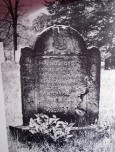
above is the tombstone of The Reverend John Graham located in White Oak Cemetery in Woodbury, Connecticut
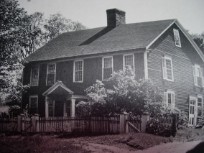
above is the home of The Reverend John Graham in Southbury, Connecticut
Narcissus Graham (1762-1829)
Named in grateful memory of Narcissus Marsh, Primate of the Anglican Church of Ireland (1702-1713) who came to the assistance of the Grahams (Presbyterian dissenters) to see that justice was done.
In 1730, the Rev. John Graham, then living in Stafford, Conn., went back to his old home in Armagh, Ireland "to attend to his temporal affairs." When he returned to his family in Stafford, we can well imagine how his three children, Elizabeth, John, Jr. and Robert must have gathered about him, as he sat by the log fire and begged for stories of his trip--of the sea and of the big ship which had brought him safely home. He must have told them of his childhood and how difficult it was for the little Scotch boys who did not belong to the Church of England to get an education since all doors were closed to Presbyterians in Ireland. Indeed, if if had not been for the English Primate Narcissus Marsh, who befriended them and helped them in all thier difficult situations, their father would never have been able to go to college and could not have been a minister. Something of the love and reverence which the Rev. John felt for the old Primate must have passed down to John Jr., for when his own sons were born, after naming the first for his father, the second for his mother's father, and the third for his older brother Robert, the fourth son was called Narcissus.
Narcissus served in the Revolutionary war from the beginning until the end, starting at age 14 in the Fife and Drum Corps. Peace was declared in 1783 and Narcissus returned home. However, after the close of the war there is no mention of him in any Connecticut records or in any family papers. For some time he was unable to be traced further. Then, by chance, a memorandum was found in the Bible of his nephew, Moses King, son of Ruth (Graham) King, which said that Narcissus had married a daughter of George Merrill and that he had gone to the high hills of Santee. No proof of the first statement can be found; but the second one was very helpful tracing Narcissus as it led the search of South Carolina records where lie the "high hills of Santee."
Narcissus must have heard a great deal of talk during and after the war from soldiers returning from the South. Perhaps their glowing accounts made him decide to settle in South Carolina. Much land was granted to the Revolutionary soldiers; and in 1786 Narcissus received from the government 500 acres in South Carolina.
Narcissus Graham enlisted in the Continental Army on Mar.17, 1777, at age 14. He was put initially in the Fife & Drum Corps of Capt. John Harmon’s Company in the 4th Connecticut Regiment commanded by John Durkee, Esq. The War Department’s records show that, upon enlisting, he was issued “1 coat, 1 vest, 1 shirt, 1 Hunting Shirt, 1 pair shoes, 1 overalls - valued at $25 & 30/90, leaving balance due to him of $22 & 30/90.” This apparently had to last him the next 6 years. He was on furlough from Dec.1777 to March 1778. He was furloughed again Nov.20, 1779, for 30 days. He was sick in Suffield, May 10, 1780, & reported sick at Danbury in August 1780. The last muster roll his name appears on was on May 27, 1783. In 1941, Miltimore Brush of Germantown, NY, had 85 letters written by Narcissus during the war. They had been bound between layers of silk gauze but were written on the cheapest kind of paper, many on mere scraps. They tell of his suffering & privations & his desire to get out of the military by hiring a substitute. However, he stayed for the entire war.
from The Reverend John Graham of Woodbury Connecticut, by Helen Graham Carpenter
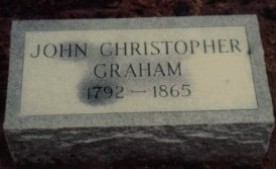
John Christopher Graham (1792-1865)
Narcissus Graham and John Christopher sold one hundred and thirty acres of land on Jack's Creek in Sumter District to John Ragin in 1816. Twenty acres of that land was "purchased by the said John C. Graham of Samuel Reily as appears by his Conveyance for the same bearing the date the 30th and 31st days of December 1794." Narcissus purchased the twenty acres in the name of his son, John Christopher, who was then only about two years old. After the sale of the land on Jack's Creek, John Christopher remained in Clarendon County, a part of Sumter District, while his father and two brothers James Edward and Charles G. went to the neighboring Richland District. John Christopher moved to a plantation near Wrights Bluff on the Santee River close to the mouth of Jack's Creek. His house was called the Old White House. From 1840 to 1855 he ran a freight boat from Wrights Bluff to Georgetown at the head of Winoyah Bay. John Christopher mortgaged to James R. Brock two tracts of land containing "283 acres more or less bounded North by lands of T. C. Richardson, East by land of W. R. Stukes and J. P. Richardson, South by land of R. W. and G. W. Stukes and West by T. C. Richardson; also three negro slaves." This mortgage was recorded Jan 19, 1844. On Jan 6, 1844, he bought for $500 from William G. Williams "all right and title to the lands on the East side of Big branch, waters of Jack's creek, being part of two tracts, one originally granted to Amey Hilton, Dec. 24, 1772, bounded W. by lands of Thomas C. Richardson, South by J. C. Graham, East by W. W. Stukes and North by William G. Williams. The other tract granted to James Hilton and Comfort Strange, on the East side of Big branch, said district, bounded West by Thomas C. Richardson, and East by W. W. Stukes." The deed was recorded June 2, 1855. On the same day was recorded a deed, dated Jan. 13, 1855, in which John C. Graham sold to Richard I. Manning "a tract of land where he now lives containing 286 acres in Sumter district on Big branch and Denny branch, bounded N. and W. by Richard I. Manning, South by land lately owned by Jonothan N. Mims, and George W. Stukes, now by renunciation of dower by his wife and it was witnessed by his son, John Powell Graham and his daughter Margaret (Graham) Parler. John Christopher had ten daughters and four sons. All four sons served in the Confederate Army, and three lost their lives. from The Reverend John Graham of Woodbury Connecticut, by Helen Graham Carpenter
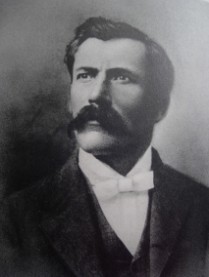
left: John Christopher Graham
above: gravestone of John Christopher Graham, buried at Rehobeth Cemetary, Clarendon County, South Carolina